We do not diagnose disease or recommend a dietary supplement for the treatment of disease. You should share this information with your physician who can determine what nutrition, disease and injury treatment regimen is best for you. You can search this site or the web for topics of interest that I may have written (use Dr Simone and topic).
“We provide truthful information without emotion or influence from the medical establishment, pharmaceutical industry, national organizations, special interest groups or government agencies.” Charles B Simone, M.MS., M.D.
Feb 21, 2020, Updated November, 2026 https://bit.ly/2PeZM8K Full Report Dr Charles Simone, M.MS., M.D.
https://www.simonesuperenergy.com/wp-content/uploads/2020/02/CLINICAL-TRIAL-SPONSORS.wav
CLINICAL TRIAL SPONSORS: (1) KEEP RESULTS SECRET, (2) DON’T PAY $131 BILLION IN FINES, AND (3) HARM PATIENTS
The Food and Drug Administration and the National Institutes of Health wrongly allow clinical trial sponsors: (1) to keep their results secret, (2) escape from paying $131 billion* in fines since the law was enacted in 2007 requiring disclosure of results, and (3) harm patients. This is more than $13,000 per day in fines for not reporting results. Any group that conducts clinical trials are required to record their results within one year of trial completion on the NIH’s website ClinicalTrials.gov. Because of its common format, this site, that has 215 million monthly page views, allows for easy comparison of results. Physicians and patients rely on trial results to see whether new treatments are safe and effective.
The total amount owed to the U.S. taxpayer from more than 17,105 Big Pharma companies and Research Institutions as of November 2026 is $131 billion.* *https://fdaaa.trialstracker.net/ Click on the tracker for updated amount.
The FDA and NIH can enforce the law at any time – but they have not.
The FDA has the authority to levy daily civil money penalties and seek federal injunctions or criminal prosecution to collect $131 billion* owed to the American taxpayer as of November 2026. The FDA chooses not to collect a single dollar. The FDA rarely issues formal Notices of Noncompliance. Instead, it relies on sending informal “Pre-Notice” letters for voluntary corrective action, resulting in years of missing data remaining largely unpenalized. So in April 2026, the FDA sent more than 2,200 warning letters involving over 3,000 clinical trials that appeared noncompliant.
The NIH can stop funding those who ignore the law – but they have not.
Pharmaceutical companies and research institutions fit the criteria of the Trump administration’s anti-fraud campaign—specifically through the Task Force to Eliminate Fraud and the False Claims Act—by suppressing negative clinical trial results and avoiding statutory fines. Under the FDA Amendments Act of 2007, failing to report results is illegal; when companies hide safety data while billing Medicare or Medicaid, it constitutes a false claim. Furthermore, deliberately avoiding the inflation-adjusted daily fines (over $13,000 per day) for non-compliance is legally classified as a “reverse false claim,” treating uncollected penalties as a debt owed to the U.S. Treasury.
The DOJ is actively targeting the healthcare sector, leveraging a new Fraud Whistleblower Incentive Program to claw back billions in uncollected funds. This risk extends across the board: research institutions like Mayo Clinic and MD Anderson have shown high historical reporting failure rates, federal agencies like the NIH have struggled with internal oversight, and Big Pharma entities face the highest financial liability for accrued debts.
In January 2020 more than 4700 clinical trials were reviewed in the journal Science: 45% reported results on time, 32% did not report at all, and 23% reported late. They include universities, NIH itself, and more than 20 Big Pharma companies. https://www.science.org/content/article/fda-and-nih-let-clinical-trial-sponsors-keep-results-secret-and-break-law. Similar results were published in the Lancet on February 01, 2020.
Failure to report negative or inconclusive studies distorts medical evidence, influences prescribing patterns, and undermines informed patient care. The missing or delayed results provide potentially crucial information for the most desperate patients, and the infractions apply to trials in almost every area of medicine. One long-overdue trial, for instance, examined the effectiveness of several chemotherapy regimens in 200 patients with advanced lymphoma; another, conducted almost two years later, compares immunotherapy to traditional chemotherapy in approximately 600 patients with late-stage lung cancer. And in hundreds of cases where the sponsors got credit for reporting trial results, they have yet to be publicly posted because of quality lapses flagged by ClinicalTrials.gov staff. Some top offenders:
Major Organizations Cited in Reporting Analyses
Group 1. Academic / Nonprofit Institutions
-
-
-
-
MD Anderson Cancer Center
-
Massachusetts General Hospital
-
Harvard University–affiliated Boston Children’s Hospital
-
Mayo Clinic
-
Memorial Sloan Kettering Cancer Center
-
Yale
-
University of Minnesota
-
Baylor College of Medicine
-
University of California San Francisco
-
Duke University
-
University of Pennsylvania
-
-
-
Group 2. Federal Agencies
-
-
-
-
National Cancer Institute
-
National Institute of Allergy and Infectious Diseases
-
National Heart Lung and Blood Institute
-
VA Office of Research and Development
-
-
-
Group 3. Big Pharma
-
-
-
-
Pfizer
-
Novartis
-
Gilead Sciences
-
GlaxoSmithKline (GSK)
-
AstraZeneca
-
Eli Lilly and Company
-
Amgen
-
Bristol Myers Squibb
-
Merck and Company
-
Hoffman LaRoche
-
-
-
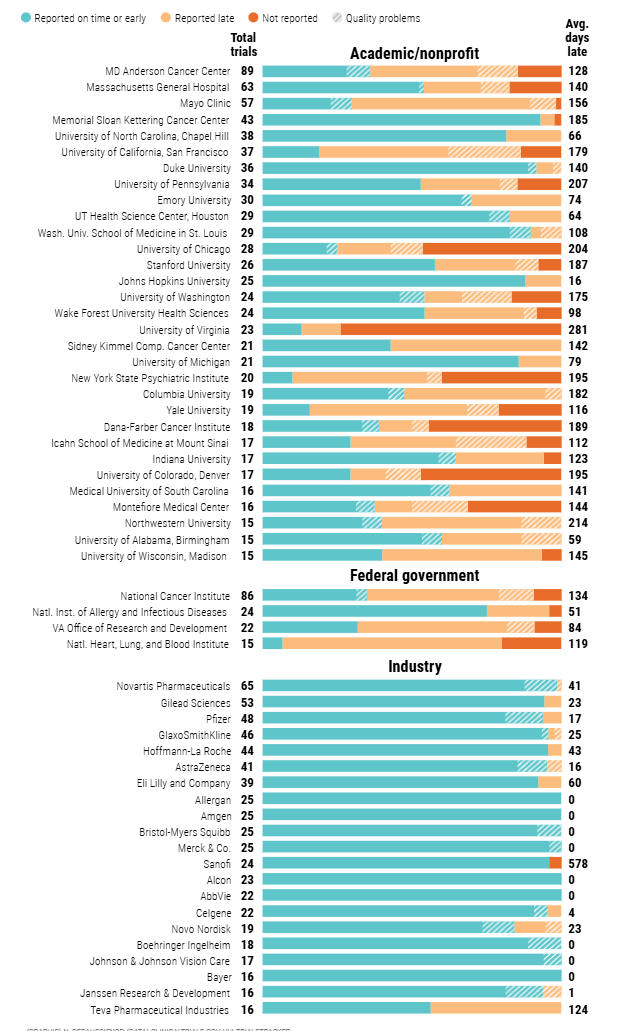
Science analyzed ClinicalTrials.gov records of all clinical trials with results legally required to be reported between 18 January 2018 and 25 September 2019. The chart, covering trial sponsors with 15 or more results due in that window or reported early, shows that some results deposited were not posted due to quality lapses.
Critics of the mandatory reporting law say that physicians can learn from peer-reviewed medical/scientific journals. But thousands of trials are not published because the treatments have been shown to be ineffective.
ClinicalTrials.gov was created by Congress in 1997 because patients said they were harmed since Big Pharma did not disclose information that their medicines were ineffective or harmful. One case often cited in legal filings and a report in the British Medical Journal is of Paxil, GlaxoSmithKline’s antidepressant, in which the company kept secret that the drug was not effective and caused suicidal ideation in teenagers. And yet their sales force encouraged physicians to prescribe it to teenagers.
Legal Summary
Under federal law, Big Pharma and research institutions commit actionable fraud when they suppress negative clinical data or evade mandatory fines. While Executive Order 14395 and the Trump administration’s Task Force to Eliminate Fraud primarily focus public messaging on welfare and benefit distribution, the enforcement mechanics (specifically the False Claims Act) fully apply to pharmaceutical and institutional misconduct. The DOJ is actively targeting the healthcare sector.
Number 1. Legal Fraud Mechanics vs. Policy Focus
-
-
False Claims via Data Suppression: Withholding negative clinical data while billing federal healthcare programs (Medicare/Medicaid) misrepresents product safety/efficacy. Under the False Claims Act (FCA), this turns healthcare reimbursements into illegal false claims.
-
Reverse False Claims via Unpaid Fines: Intentionally withholding or avoiding statutory fines mandated by the Food and Drug Administration Amendments Act of 2007 (FDAAA)—more than $13,000 per day per unreported trial—constitutes a “Reverse False Claim” (deliberately concealing a financial debt owed to the federal government).
-
Policy vs. Practice: The White House Task Force targets systemic benefit abuses (welfare, self-certification) as its top priority. However, the DOJ heavily relies on the False Claims Act (FCA) as its primary tool for enforcement, with life sciences accounting for over half of major annual recoveries.
-
Number 2. Industry-Wide Compliance & Fraud Risks – tracking by independent groups and federal agencies reveals widespread compliance failures across three major sectors:
Entity Category |
Key Cited Organizations |
Documented Compliance Failures |
Core Fraud Risk Under Anti-Fraud Framework |
Big Pharma |
Pfizer, Novartis, Gilead, GSK, AstraZeneca, Eli Lilly, Amgen, BMS, Merck, Roche |
Accumulation of tens of billions of dollars in uncollected statutory fines ($12,103/day). |
Reverse False Claims: Corporate concealment of past-due statutory debts owed to the U.S. Treasury, targeted via whistleblower incentives. |
Academic & Nonprofits |
MD Anderson, Mayo Clinic, MGH, MSKCC, UCSF, Duke, Penn |
Historically failed to report results on time or at all in ~66% of eligible clinical trials. |
Grant Fraud & False Claims Act: Accepting federal grants while misrepresenting compliance with research integrity rules. |
Federal Agencies |
NCI, NIAID, NHLBI, VA Research & Development |
Over 60% of trials overseen or funded by key NIH institutes historically faced reporting delays. |
FDA Directives: Explicitly targeted by mass enforcement notices. |
We need an NIH Director and an FDA Commissioner who together with the DOJ will enforce the law, collect the billions of dollars in fines, and stop funding non-compliant trial sponsors.
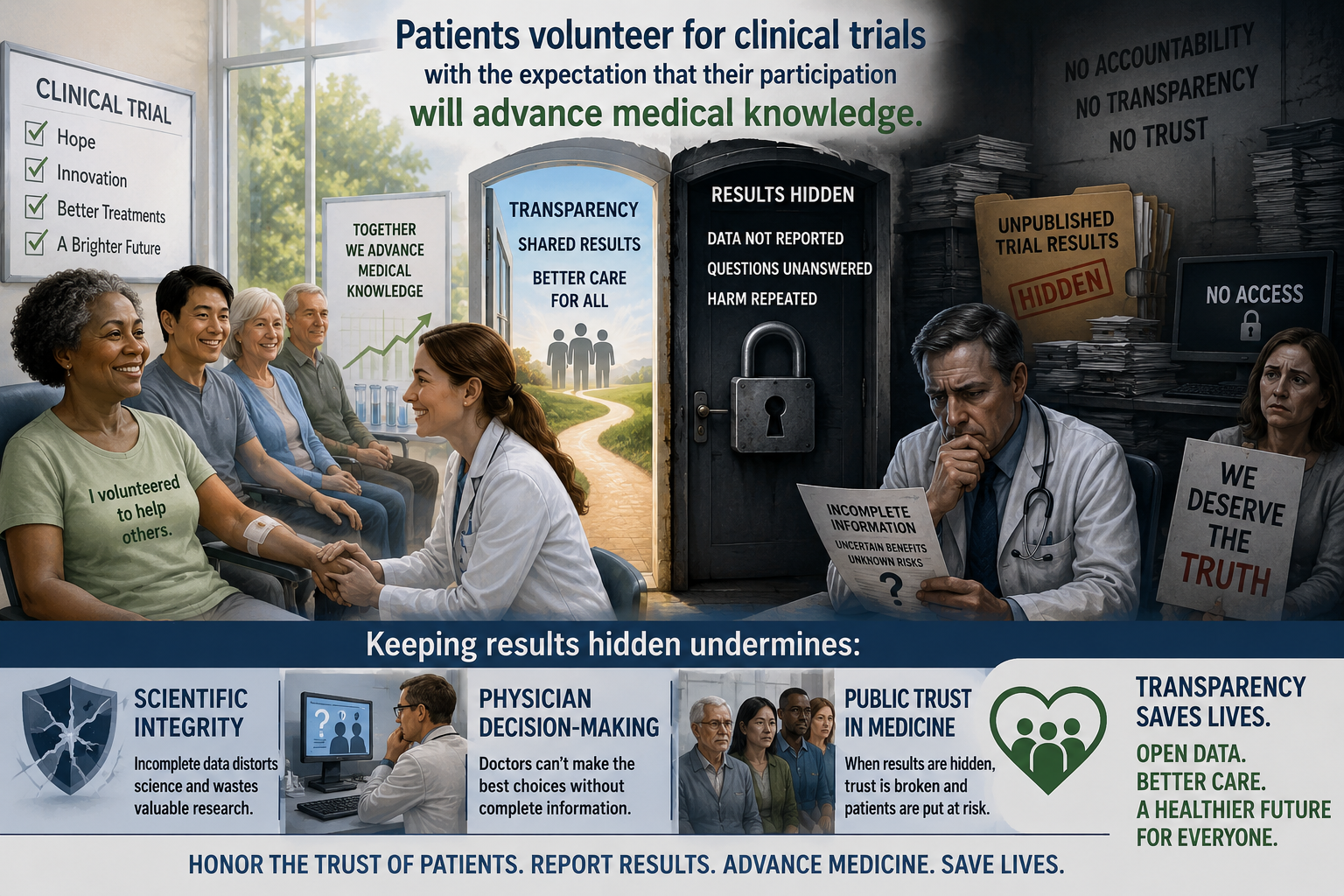
Physicians and patients rely on trial results to see whether new treatments are safe and effective. Patients volunteer for clinical trials with the expectation that their participation will advance medical knowledge. Keeping results hidden undermines scientific integrity, physician decision-making, and public trust in medicine.