MARIJUANA EDIBLES
May 16, 2017, Updated March 20, 2019
We do not diagnose disease or recommend a dietary supplement for the treatment of disease. You should share this information with your physician who can determine what nutrition, disease and injury treatment regimen is best for you. You can search this site or the web for topics of interest that I may have written (use Dr Simone and topic).
“We provide truthful information without emotion or influence from the medical establishment, pharmaceutical industry, national organizations, special interest groups or government agencies.” Charles B Simone, M.MS., M.D.
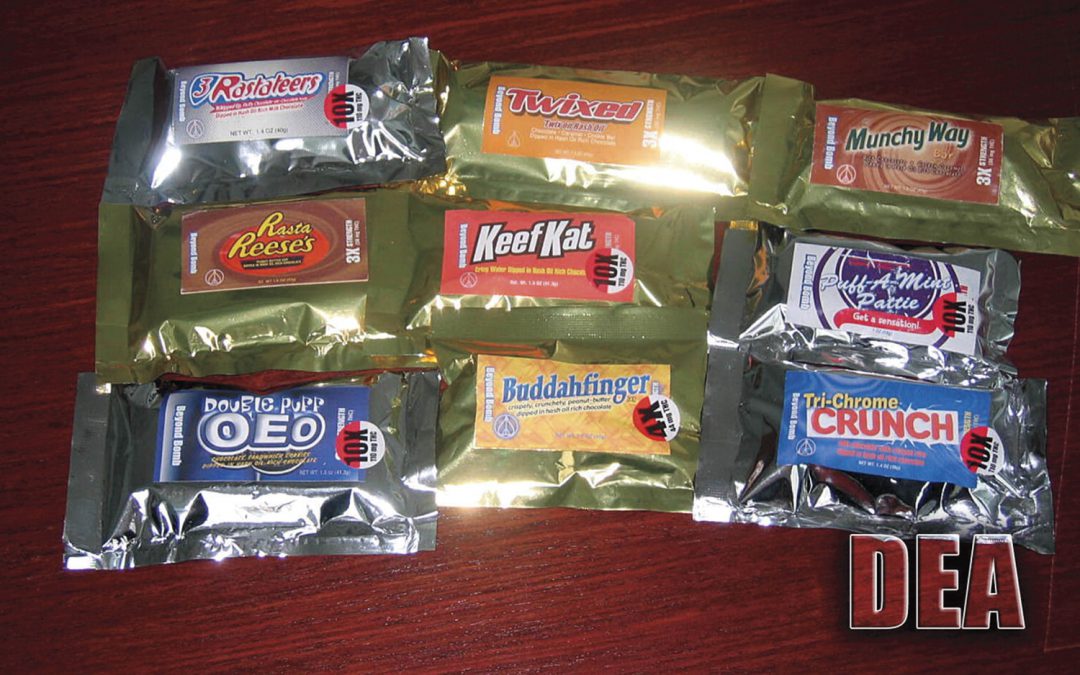
Lawrenceville, NJ (Dr. Simone) – Does this packaging look familiar? So it would also to children in Colorado, Washington State, and soon in Alaska and Oregon. Over-intoxication could be common because some of these products contain 4 or 5 times the “normal” amount that when ingested rather than smoked increases the metabolic effects of marijuana. The majority of marijuana related events of children rushed to emergency rooms in Colorado were because of edibles.
So far the federal government, Food and Drug Administration and Justice Department, are not regulating edibles. Marijuana is a Schedule I controlled substance which means it has a “high potential for abuse, has no accepted medical use, and is not safe even under medical supervision.” The FDA cannot regulate it as a drug because it is a Schedule I substance. But the FDA could consider marijuana edibles a food. Foods must contain only what is “generally recognized as safe.” Clearly marijuana is not recognized as safe. However, the FDA can’t regulate marijuana edibles sales because sales of marijuana are prohibited by federal law.
The Justice Department could enforce the Controlled Substance Act but considers this not a priority because the consumer is protected by state and local laws. However, the Justice Department can prosecute if it deems legalized marijuana is a threat to national interests such as distribution to minors.
Another avenue of control is through candy companies. Hersey has sued for trademark infringement and prevailed against one of the edible manufacturers.
Hopefully it won’t take a child’s tragedy to get the federal government involved.
Who will pay for higher health costs and diminished capabilities for those who use it? The politicians and lobbyists who vote for its availability should be directly financially responsible, as should also the sellers of marijuana.
MEDICAL FACTS (NEJM June 5, 2014; Eur J Emerg Med 2006; JAMA Dec 2025)
-
UCLA Study – No Evidence that Medical Cannabis Works: Despite being legal in 40 states and a $32 billion industry, a December 2025 review by UCLA researchers published in JAMA found that medical cannabis lacks “gold standard” evidence for treating chronic pain, anxiety, and insomnia (https://jamanetwork.com/journals/jama/article-abstract/2842072).
-
“The evidence does not support the use of cannabis or cannabinoids at this point for most of the indications that folks are using it for,” lead study author Dr. Michael Hsu, an addiction psychiatrist at UCLA, told The New York Times.
After reviewing over 2,500 articles published from January 2010 through September 2025 including randomized clinical trials, meta-analyses and clinical guidelines, the researchers highlighted significant safety concerns:
-
Addiction: Approximately 29% of medical cannabis users meet the criteria for Cannabis Use Disorder – Addiction.
-
Mental Health: High-potency products are linked to higher rates of psychosis and generalized anxiety, particularly in adolescents.
-
Heart Health: Daily use, especially of inhaled products, is associated with increased risks of heart attack, stroke, and coronary heart disease.
-
-
Addiction to Marijuana and other substances is high
-
Abnormal Brain development
-
Respiratory insufficiency and Coma
-
Impaired short term memory, difficult to learn and retain information
-
Altered judgement that increases risk of sexually transmitted diseases
-
Progression to use of other drugs
-
-
Depression or Anxiety
-
Diminished lifetime achievement : poor education outcome, high dropout rate, cognitive impairment, lower I.Q. for those who started using in adolescence.
-
Motor vehicle accidents – car crashes rose 6% from 2012 to 2017 in 4 states that legalized marijuana (Nevada, Colorado, Washington, Oregon) compared to 4 states that did not.
-
Symptoms of chronic bronchitis
-
Higher risk of cancer and cardiovascular disease
-
Effects of marijuana on athletic performance
Impairs skills requiring eye-hand coordination and a fast reaction time
Reduces motor coordination, tracking ability and perceptual accuracy that may last up to 24 to 36 hours after usage
Reduces maximal exercise capacity resulting in increased fatigue
Impairs concentration
Marijuana has no performance-enhancing potential
“I smoked pot as a kid, and I view it as a bad habit and a vice, not very different from the cigarettes that I smoked as a young person up through a big chunk of my adult life. I don’t think it is more dangerous than alcohol.” Barack Obama, President of the United States, The New Yorker Magazine January 27, 2014.
-
Approximately 25 million Americans struggle with substance use disorders.
-
Opioids are involved in nearly 70% of drug overdose deaths.
-
About 5 million Americans misuse prescription pain relievers.
-
Marijuana remains the most commonly used illicit drug, with around 48 million users.
-
Cocaine use has increased, with about 1.5 million Americans reporting use in the past year.
-
Methamphetamine use has surged, with over 1.6 million users reported.
Overview of marijuana (cannabis) use in the United States by age, based on the most recent national survey data (primarily from the 2023 – 2024 National Survey on Drug Use and Health (NSDUH) and other major public health research):
Marijuana Use in the U.S. by Age – Overall Prevalence (Past Year, 2022-2023)
-
About 22% of people aged 12 or older reported using marijuana in the past year in 2022. (drugpolicyfacts.org)
-
Marijuana is the most commonly reported federally illegal drug in the U.S. by prevalence. (CDC)
Adolescents (Age 12–17)
-
Estimated ~11.5 % of adolescents (12–17) reported past-year marijuana use in 2022. (drugpolicyfacts.org)
-
Initiation rates (new users) are higher in this group than adults, with ~3.5 % initiating use in the past year. (SAMHSA)
Young Adults (Ages 18–25)
-
This group consistently shows the highest prevalence of use:
-
Roughly 38 % of 18-25 year-olds used marijuana in the past year (2022 data). (drugpolicyfacts.org)
-
National surveys (Monitoring the Future) also show their highest reported use among surveyed adults, peaking around 40 + % in recent years. (National Institutes of Health (NIH))
-
Initiation rates (new use) among young adults were about 2.9 % in 2024. (SAMHSA)
Adults (Ages 26 +)
-
Adults aged 26 and older had a past-year use rate of about 20.6 % in 2022. (drugpolicyfacts.org)
-
Prevalence generally declines with age within adults but remains significant:
-
CDC survey data shows current use rates (in 2022) roughly:
-
25–34: ~24 %
-
35–44: ~19 %
-
45–54: ~13 %
(These figures are from a state-level Behavioral Risk Factor Surveillance System subset.) (CDC)
Older Adults (Ages 65 +)
-
Use among older adults has been increasing significantly:
-
Recent research reported about 7 % of adults 65+ used marijuana in the past month (2023) — a large increase over the past few years. (Axios)
Key Patterns by Age
Age Group
|
Approximate Past-Year Use (%)
|
Notes
|
12–17
|
11.5 %
|
Lower than adults; initiation still notable. (drugpolicyfacts.org)
|
18–25
|
38 – 42 %
|
Highest prevalence among all age groups. (drugpolicyfacts.org)
|
26–34
|
20 – 24 %
|
Young adults beyond college age. (CDC)
|
35–44
|
19 %
|
Moderate adult use. (CDC)
|
45–54
|
13 %
|
Declines with age. (CDC)
|
65+
|
7 % (past month)
|
Rapidly increasing pattern in recent years. (Axios)
|
Additional Age-Related Use Insights
-
Smoking remains the most common method across age groups, with 74 %-84 % of users reporting this mode. (SAMHSA)
-
Initiation of use still happens most often in teens and young adults, even though overall initiation rates are relatively low. (SAMHSA)
-
Younger age groups tend to use cannabis more frequently and via varied methods (vaping, edibles) compared with older adults. (SAMHSA)
SUMMARY
-
Young adults (18-25) have the highest marijuana use rates in the U.S.
-
Adult use remains common, with notable prevalence through age 54 and beyond.
-
Older adult use is rising rapidly, though still lower than in younger groups.
-
Adolescent use is lower than adult use, but initiation often occurs before age 21.
© 2017 – 2026 Charles B Simone, M.MS., M.D.