We do not diagnose disease or recommend a treatment protocol or dietary supplement for the treatment of disease. You should share this information with your physician who can determine what nutrition and disease treatment regimen is best for you. Ask your physician any questions you have concerning your medical condition. You can search this site or the web for topics of interest that I may have written (use Dr Simone and topic).
“We provide truthful information without emotion or influence from the medical establishment, pharmaceutical industry, national organizations, special interest groups or government agencies.” Charles B Simone, M.MS., M.D.
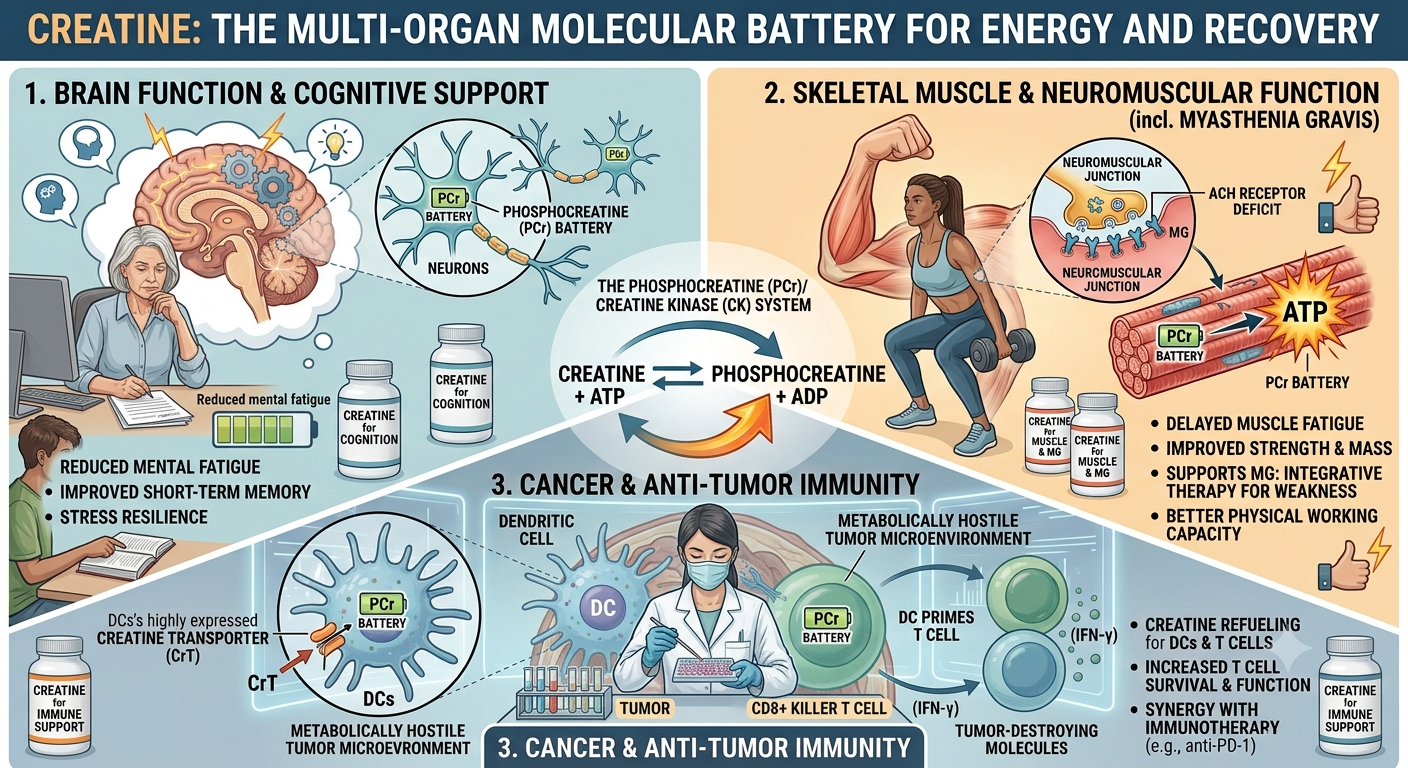
CREATINE BENEFITS THE BRAIN, THE MUSCLE, AND THE IMMUNE SYSTEM
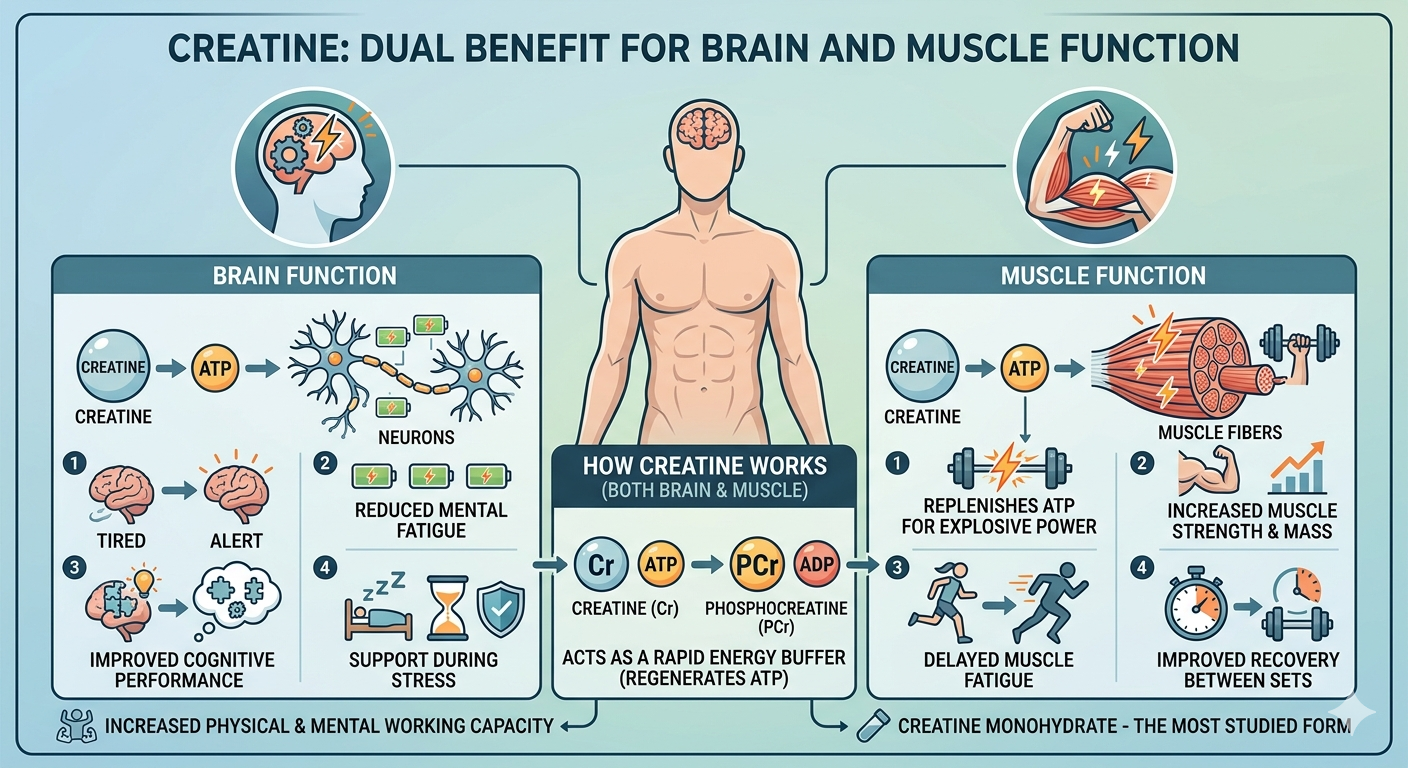
The brain absolutely needs creatine.While creatine is famous for building muscle, the brain is actually one of the most energy-demanding organs in the body—accounting for about 20% of your total energy consumption despite being only 2% of your body weight.
Creatine supplementation may improve cognitive function, improve memory, and boost mood, particularly in individuals experiencing stress or sleep deprivation and for both vegetarians and older adults, as they typically have lower baseline levels of creatine.
Creatine acts as a “backup battery,” helping to rapidly regenerate ATP (cellular energy) during periods of high demand or stress.
Does the Brain Need It?
Your brain naturally produces some creatine, but it also absorbs it from your diet (meat and fish).Research shows that increasing these levels through supplementation can provide several benefits, particularly when the brain is “stressed.”
About 1 to 2 grams of creatine are synthesized in your body each day and you eat about 1 to 2 grams more. Muscular activity quickly depletes a main source of energy called ATP – Adenosine Tri-Phosphate. Creatine phosphate is the main source of high-energy phosphate bonds in muscle and nerves critical to the formation of ATP. Creatine improved cycling times for cyclists. Muscles readily absorb dietary creatine and doses of 5 grams four times a day for 5 days can replete a muscle deficiency. Taking low doses while thoroughly hydrated is generally safe – hydration is the key. Taken from
Reduced Mental Fatigue: Studies show it helps maintain performance during repetitive or difficult cognitive tasks.
Stress Resilience: It is most effective when the brain is under metabolic stress, such as sleep deprivation, hypoxia (low oxygen), or aging.
Memory & Processing: Some evidence suggests improvements in short-term memory and reasoning, especially in vegetarians or older adults who may have lower baseline levels.
Neuroprotection: It is being studied for its role in recovering from mild traumatic brain injuries (concussions) and supporting those with neurodegenerative conditions.
Recommended Doses
The “standard” muscle-building dose (3–5g) may not be enough for the brain.Because the blood-brain barrier is very selective, it is harder to get creatine into the brain than into muscle.
Goal
Protocol
Standard Brain Support
5–10g per day (Ongoing maintenance).
Rapid Brain Loading
20g per day for 5–7 days (often split into four 5g doses), followed by a maintenance phase.
Vegetarians/Seniors
5g per day typically shows significant cognitive benefits since baseline levels are often lower.
Note: High doses (20g+) are generally safe but can cause mild bloating or GI distress in some people. Taking it with water is essential as creatine draws water into cells.
Key Scientific References
Avgerinos et al. (2018): A systematic review in Experimental Gerontology found that creatine supplementation can improve short-term memory and intelligence/reasoning in healthy individuals.
Rae et al. (2003): A famous double-blind study showing that 5g/day for six weeks significantly improved working memory and IQ scores in vegetarians.
Watanabe et al. (2002): Published in Neuroscience Research, this study demonstrated that 8g/day for 5 days reduced mental fatigue during mathematical tasks.
Forbes et al. (2022): A review in Nutrients highlighting that higher doses (up to 20g) might be necessary to overcome the blood-brain barrier for maximum neurological benefit.
Roschel et al. (2021): A comprehensive review in Nutrients titled “Creatine Supplementation and Brain Health” which explores its use in aging and clinical conditions.
The Verdict: If you are well-rested and eat a high-protein diet, you might not feel a “buzz.” But if you’re sleep-deprived, older, or vegetarian, creatine is one of the most science-backed “nootropics” (brain supplements) available.
Myasthenia Gravis (MG)
In patients with Myasthenia Gravis (MG), creatine is considered an “integrative therapeutic” that may help manage muscle weakness and fatigue. Because MG is characterized by a failure of neuromuscular transmission, the muscles themselves often become “energy-starved” or deconditioned.
Creatine supplementation is thought to provide a metabolic buffer, helping these compromised muscles maintain ATP (energy) levels during activity.
Key Benefits for Myasthenia Gravis
1. Improved Muscle Strength & Mass
Patients with MG often experience muscle atrophy and significant weakness due to reduced activity and the condition itself.
Case Study Insight: A 15-week study on a patient with MG combined resistance training with creatine supplementation. The results showed a 37% increase in leg extension strength and a 6.8% increase in body weight (primarily fat-free mass).
Mechanism: Creatine increases the availability of phosphocreatine in the muscle, which is essential for the rapid resynthesis of ATP during the brief, intense contractions used in strength training.
2. Delaying Neuromuscular Fatigue
While creatine cannot fix the underlying antibody-driven communication problem at the neuromuscular junction, it can improve the “Physical Working Capacity” of the muscle.
By increasing the energy reservoir within the muscle fiber, creatine may help a patient perform more “work” (movements) before reaching the point of total exhaustion.
3. Neuroprotection & Recovery
Research into various neuromuscular diseases (including MG and muscular dystrophies) suggests that creatine may protect muscle cells from metabolic stress and improve the efficiency of the “calcium pump,” which is critical for muscle relaxation and subsequent contraction.
Recommended Doses for MG
Clinical studies in neuromuscular populations typically use one of two approaches:
Loading Phase: 20g per day (split into four 5g doses) for 5 days.
Maintenance Phase: 5g per day is the most common long-term dose for maintaining elevated muscle creatine stores.
Critical Safety Considerations
Kidney Function: Because some MG medications (like cyclosporine) can affect the kidneys, it is vital to have your renal function checked before starting creatine.
Hydration: Creatine pulls water into the muscles; you must increase your daily water intake to avoid cramping or dehydration.
Avoid Magnesium: Unlike creatine, magnesium is often contraindicated in MG as it can interfere with neuromuscular transmission.
Scientific References
Gentil, P., et al. (2001).“Effects of resistance exercise and creatine supplementation on myasthenia gravis: a case study.” Published in Medicine and Science in Sports and Exercise. This is the primary case study specifically looking at MG.
Kley, R. A., et al. (2013/2021 update).“Creatine for treating muscle disorders.”Cochrane Database of Systematic Reviews. A large-scale meta-analysis showing that creatine significantly increases muscle strength in various neuromuscular diseases.
Tarnopolsky, M. A., & Martin, J. (1999).“Creatine monohydrate increases strength in patients with neuromuscular disease.”Neurology. A foundational study demonstrating the safety and efficacy of creatine across different muscle-wasting conditions.
Stout, J. R., et al. (2001).“Effects of creatine supplementation on the onset of neuromuscular fatigue threshold.”Journal of Applied Physiology. (Applicable to the fatigue management aspect of MG).
Life Extension (2024/2025 Protocols).“Myasthenia Gravis Integrative Therapeutics.” Notes creatine as a supportive supplement for easing symptoms of skeletal muscle weakness.
Disclaimer:Because Myasthenia Gravis is a complex autoimmune condition, you should always consult your neurologist before adding any supplement to your regimen, especially if you are taking pyridostigmine (Mestinon) or immunosuppressants.
Oncology and Immunology
The role of creatine in oncology and immunology represents an exciting frontier in biomedical research. While historically viewed strictly as a muscle-building supplement, pioneering research reveals that creatine acts as a critical “molecular battery” that helps the immune system wage war against tumors.
1. Fueling the Immune “Command Center” (Dendritic Cells)
Recent studies highlight how creatine serves as a lifeline for dendritic cells, the immune system’s specialized messengers responsible for capturing tumor fragments and training killer T cells to attack.
Overcoming Metabolic Hostility: The tumor microenvironment is nutrient-poor and highly competitive. Tumor cells aggressively consume glucose and other nutrients, leaving immune cells energetically starved.
The CrT Transporter Safeguard: Researchers discovered that dendritic cells inside tumors heavily upregulate the expression of the creatine transporter (CrT). By pumping more creatine into the cell, it acts as an energy reserve that maintains optimal ATP levels.
Activation and Survival: When dendritic cells are genetically modified to lack this transporter, their survival rates plunge, they struggle to mature, and they fail to effectively prime the rest of the immune system to recognize cancer. Supplementing with creatine preserves the crucial inflammatory signaling pathways these cells need to activate.
2. Energizing the “Foot Soldiers” (CD8+ Killer T Cells)
The benefit of creatine stretches directly to the cells executing the attack.
Foundational work by the same laboratories showed that CD8+ T cells (killer T cells) heavily depend on the phosphocreatine/creatine kinase system.
When killer T cells infiltrate a tumor, they use creatine like a hybrid car uses a backup battery—drawing upon stored energy to keep multiplying and releasing tumor-destroying molecules (like IFN\gamma and granzyme B) even when short on traditional fuel. Without creatine, T cells quickly suffer from “metabolic exhaustion” and become ineffective.
3. Boosting Cancer Vaccines & Immunotherapy
Because creatine reinforces the very infrastructure of anti-tumor immunity, it holds immense promise as a clinical adjunct:
Synergy with Checkpoint Inhibitors: Preclinical models have shown that combining creatine with standard immunotherapies, such as anti-PD-1 blockade, creates a powerful synergistic effect that significantly slows tumor growth and prevents T cell exhaustion.
Enhancing Cancer Vaccines: In laboratory settings, adding creatine during the manufacturing of human dendritic cell-based vaccines significantly improves their ability to activate human T cells against cancer-associated targets.
Important Safety Note & Nuance
While preclinical data (mouse and human cell models) is incredibly promising, human clinical trials are still ongoing.
Furthermore, the relationship between creatine and cancer is nuanced. In some specific, non-immunological contexts, certain highly aggressive or metastatic cancer cells can attempt to hijack creatine metabolism to fuel their own migration. Therefore, cancer patients should never self-prescribe creatine and must always consult their oncology team before starting a regimen.
Scientific References
Kang, E., et al. (2026).“Creatine uptake promotes dendritic cell activation and enhances antitumor immunity.”iScience, 29(4), 115436. (This landmark study maps out how dendritic cells rely on the CrT transporter inside tumors).
Di Biase, S., et al. (2019).“Creatine uptake regulates CD8 T cell antitumor immunity.”Journal of Experimental Medicine, 216(12), 2869–2882. (The foundational paper identifying creatine as a molecular battery for killer T cells).
Tian, C. J., et al. (2023).“CARD9 deficiency promotes pancreatic cancer growth by blocking dendritic cell maturation via SLC6A8-mediated creatine transport.”OncoImmunology, 12(1). (Explores how restricted creatine transport leads to dendritic cell immaturity).
Pan, C., et al. (2024/2025).“It Is Not Just About Storing Energy: The Multifaceted Role of Creatine Metabolism on Cancer Biology and Immunology.”International Journal of Molecular Sciences. (A comprehensive review evaluating both the anti-tumor immune benefits and the metabolic complexities of creatine in different cancers).
 https://shop.simoneprotectivehealth.com/shop/nutritional-hydration/