We do not diagnose disease or recommend a treatment protocol or dietary supplement for the treatment of disease. You should share this information with your physician who can determine what nutrition and disease treatment regimen is best for you. Ask your physician any questions you have concerning your medical condition.
You can search this site or the web for topics of interest that I may have written (use Dr Simone and topic). “We provide truthful information without emotion or influence from the medical establishment, pharmaceutical industry, national organizations, special interest groups or government agencies.” Charles B Simone, M.MS., M.D.
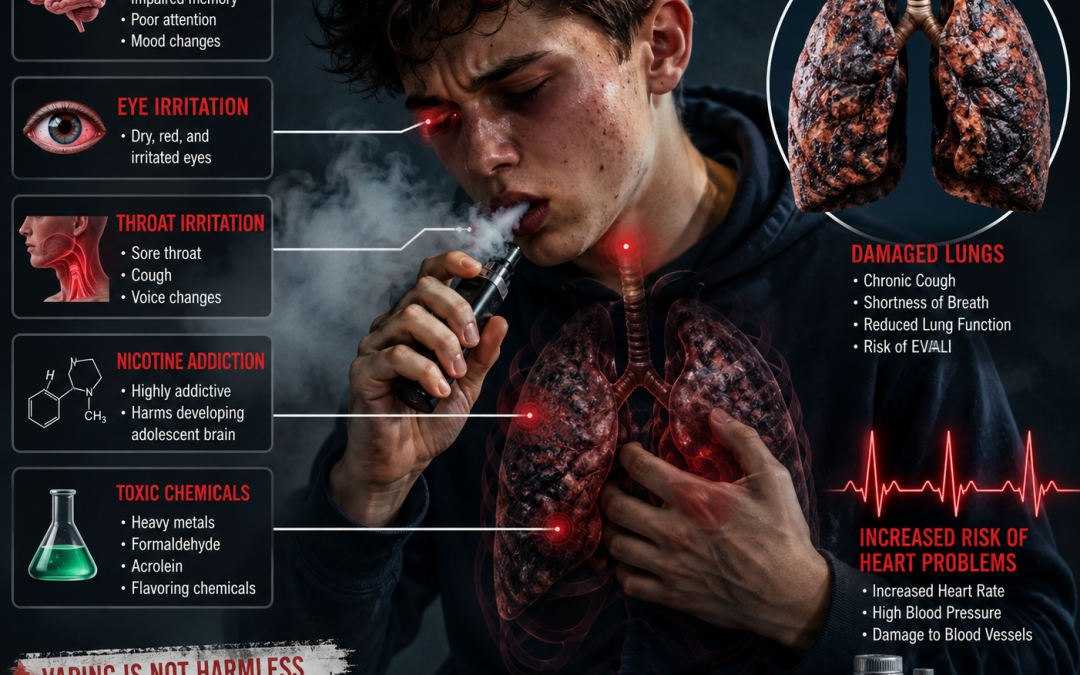
Vaping is often marketed as a cleaner alternative to smoking, but growing evidence shows that e-cigarettes can damage the lungs, heart, blood vessels, and developing brain — particularly in adolescents and young adults. While some adults use vaping as a smoking-cessation tool, vaping is not harmless, and long-term health effects are still emerging. And the flavored ones are more addictive.
On May 8, 2026 the FDA approved fruit-flavored e-cigarettes for adult use for the first time. This decision threatens the progress our nation has achieved in reducing youth e-cigarette use. It contradicts the vast amount of scientific data, the positions of the CDC, American Heart Association, the World Health Organization, and the FDA’s own repeated conclusions that vaping and especially flavors pose a serious risk to children.
Major Health Risks
1. Lung Injury and Respiratory Disease
Vaping aerosols contain ultrafine particles, volatile organic compounds, heavy metals, and chemical flavorings that can injure lung tissue.
A severe vaping-associated illness known as EVALI caused thousands of hospitalizations in the United States. Symptoms included:
Shortness of breath
Chest pain
Cough
Fever
Respiratory failure
Collapsed Lungs
Even beyond EVALI, studies show vaping may worsen:
Asthma
Chronic bronchitis symptoms
Airway inflammation
Reduced lung function
Research has linked certain flavoring chemicals such as diacetyl to bronchiolar injury sometimes called “popcorn lung.”
2. Nicotine Addiction and Brain Effects
Most vaping products contain nicotine, a highly addictive substance and the industry has engineered ways to deliver more of it. Some popular vapes can have the nicotine of 600 cigarettes. A can of pouches can have 2 times the nicotine of a pack of cigarettes. The goal is the same – RAPID ADDICTION
In adolescents and young adults, nicotine exposure may affect:
Attention – Nicotine interferes with your brain’s ability to pay attention and increases learning difficulties.
Learning
Memory
Depression and Anxiety – Nicotine can deepen depression and amplify anxiety. It may seem like your vape or pouch brings relief, but it’s really just the pausing of withdrawal symptoms.
Mood regulation – Nicotine can rewire your brain’s reward system, which can increase mood swings and make you feel super ragey between uses
Impulse control
The adolescent brain continues developing into the mid-20s, making youth especially vulnerable to addiction.
3. Cardiovascular Harm
Nicotine and aerosol chemicals may:
Increase heart rate and blood pressure
Damage blood vessels
Promote oxidative stress and inflammation
Increase risk factors for heart disease
Emerging evidence suggests vaping can impair endothelial function similarly to traditional cigarette smoking.
4. Toxic Chemical Exposure
Vape aerosols may contain:
Formaldehyde
Acetaldehyde
Acrolein
Heavy metals such as nickel, lead, and tin
Fine particulate matter
Heating coils and high-temperature aerosolization can generate toxic degradation products.
5. Poisoning and Accidental Exposure
Liquid nicotine can be dangerous if swallowed or absorbed through the skin, especially in children. Accidental poisoning cases involving vape liquids have increased with widespread e-cigarette use.
6. Gateway Concerns in Youth
Multiple observational studies have found that adolescents who vape are more likely later to experiment with combustible cigarettes or other nicotine products, though causation remains debated.
What Major Health Organizations Say
Centers for Disease Control and Prevention
The CDC warns that no youth should use e-cigarettes and that pregnant women and non-smokers should avoid vaping.
American Heart Association
The AHA states that e-cigarettes are not risk-free and raise concerns about cardiovascular and pulmonary toxicity.
World Health Organization
WHO has stated that e-cigarettes are harmful to health and are not safe.
Health Metric
Vaping Impact (vs. Non-Users)
Myocardial Infarction
53% Increased Odds
Heart Failure
19% Increased Risk
Asthma
39% Higher Odds
Cancer Indicators
DNA damage & Epigenetic changes detected
Policy Statement
Given rising evidence of pulmonary, cardiovascular, neurologic, and addiction-related harms — especially among youth — public health policy should prioritize prevention of adolescent nicotine exposure, transparent labeling of vaping products, tighter regulation of flavorings and marketing practices, and continued long-term safety research on e-cigarettes.
The federal government spends 27% of your taxes on healthcare, which is the most expensive part of the federal budget. Let’s not add to it.
KFF Health News: Trump Bought Tobacco Stocks And Raked In Industry Donations As FDA Eased Standards President Donald Trump, who once declared he had “saved” flavored vapes, grew his stock holdings this year to as much as $1.64 million in tobacco giant Philip Morris. He also had holdings in Altria and a third leading tobacco company, though an apparent discrepancy in his disclosures clouds the extent of his investments. In 2025, tobacco interests donated $6 million to MAGA Inc., a super PAC that supports the president, and Trump’s inauguration. And, on April 30, a week before FDA guidance that provided a critical boost to the industry, Reynolds American dropped an additional $5 million into the super PAC’s coffers. (Tahir, 6/11/26)”
Key Medical References
New England Journal of Medicine Layden JE et al. Pulmonary Illness Related to E-Cigarette Use in Illinois and Wisconsin. N Engl J Med. 2020.
Journal of the American College of Cardiology Qasim H et al. Short-Term E-Cigarette Exposure Increases the Risk of Thrombogenesis and Enhances Platelet Function in Mice. JACC. 2018.
Circulation Bhatta DN, Glantz SA. Association of E-Cigarette Use With Respiratory Disease and Cardiovascular Disease. Circulation. 2019.
JAMA Goriounova NA, Mansvelder HD. Short- and Long-Term Consequences of Nicotine Exposure During Adolescence for Prefrontal Cortex Neuronal Network Function. JAMA Pediatrics. 2012.
The Lancet Marques P et al. Electronic Cigarettes and Health: A Systematic Review. Lancet Respiratory Medicine.
National Academies of Sciences, Engineering, and Medicine Public Health Consequences of E-Cigarettes. 2018.