We do not diagnose disease or recommend a treatment protocol or dietary supplement for the treatment of disease. You should share this information with your physician who can determine what nutrition and disease treatment regimen is best for you. Ask your physician any questions you have concerning your medical condition.
You can search this site or the web for topics of interest that I may have written (use Dr Simone and topic). “We provide truthful information without emotion or influence from the medical establishment, pharmaceutical industry, national organizations, special interest groups or government agencies.” Charles B Simone, M.MS., M.D.
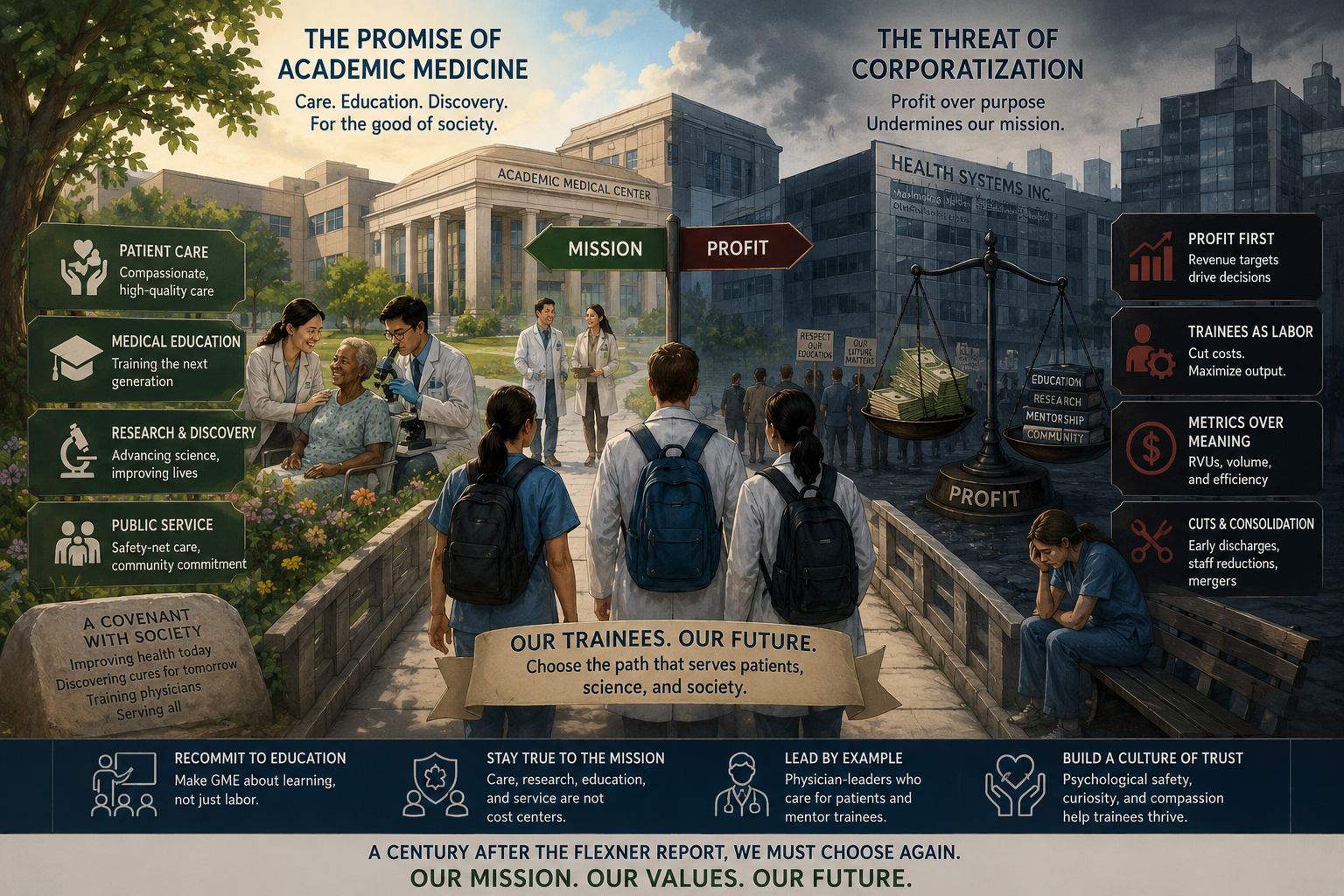
Academic medical centers were created to unite patient care, medical education, and scientific discovery. Institutions such as University of Pennsylvania, University of Michigan and Columbia University helped build a model that trained generations of physicians while advancing research and public health.
Today, that mission is increasingly threatened by corporations taking over healthcare. Many academic medical centers now prioritize profitability, productivity metrics, and operational efficiency over education, mentorship, research, and patient-centered care. Trainees often feel treated less as future physician leaders and more as inexpensive labor supporting a revenue-driven system.
The Flexner Report (1910) reformed U.S. medical education by shutting down low-quality schools, raising standards, and emphasizing scientific, university-based training. It improved professionalism and medical quality.
But critics say it also fueled corporatization: medical education became expensive, centralized, and dominated by large institutions, reducing diversity and access while prioritizing specialization and profit-driven systems over community health and preventive care.
This shift risks undermining the traditional values of academic medicine — intellectual curiosity, scientific inquiry, compassion, and mentorship — at a time when medicine is experiencing extraordinary advances in fields such as oncology, immunotherapy, and cardiovascular care.
Academic medical centers exist to serve the public through excellence in patient care, medical education, scientific discovery, and community service. These institutions must reject the growing trend toward excessive corporatization that places profitability, productivity metrics, and financial expansion above their core mission.
Medical trainees are not inexpensive labor or instruments of revenue generation. They are the future physician leaders, scientists, educators, and caregivers upon whom the health of society depends. Graduate medical education must prioritize mentorship, intellectual curiosity, ethical leadership, scientific inquiry, and compassionate patient-centered care.
Academic medical centers leadership should ensure that:
• Education and research remain central institutional priorities, not secondary cost centers.
• Physician-leaders remain actively engaged in patient care and trainee mentorship.
• Training environments promote psychological safety, professionalism, sympathy, and academic inquiry.
• Financial stewardship supports — rather than replaces — the public mission of medicine.
• Nonprofit institutions remain accountable to the communities and taxpayers that support them.
At a time of extraordinary scientific advancement, academic medicine must recommit to its foundational covenant with society: advancing science, training future physicians, and placing patients above profits.


 Academic medical centers were created to unite patient care, medical education, and scientific discovery. Institutions such as University of Pennsylvania, University of Michigan and Columbia University helped build a model that trained generations of physicians while advancing research and public health.