
We do not diagnose disease or recommend a treatment protocol or dietary supplement for the treatment of disease. You should share this information with your physician who can determine what nutrition and disease treatment regimen is best for you. Ask your physician any questions you have concerning your medical condition.
You can search this site or the web for topics of interest that I may have written (use Dr Simone and topic). “We provide truthful information without emotion or influence from the medical establishment, pharmaceutical industry, national organizations, special interest groups or government agencies.” Charles B Simone, M.MS., M.D.
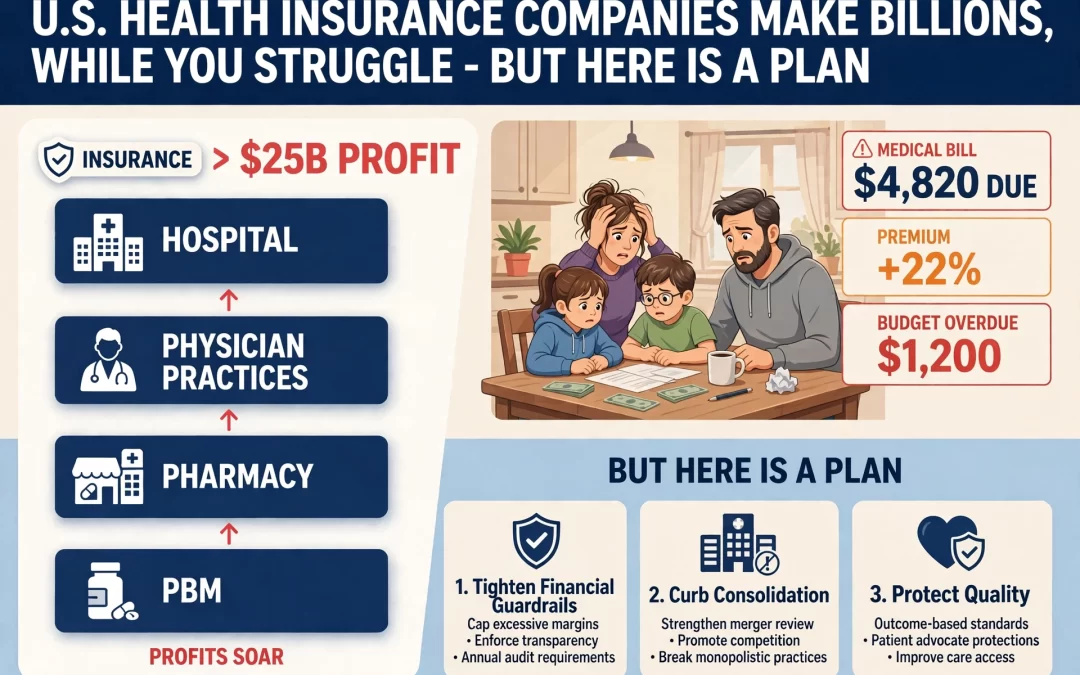
U.S. HEALTH INSURANCE COMPANIES MAKE BILLIONS, WHILE YOU STRUGGLE – BUT HERE IS A PLAN
Executive summary
The Crisis: Amid a historic affordability crisis, U.S. for-profit insurance companies posted massive 2025 net incomes — UnitedHealth Group $12.1B, Cigna $6B, Elevance Health $5.7B, Humana $1.2B — totaling over $25B in profit. Employers, facing those rising costs, are forced to either raise employee premiums or suppress wage growth. The result: a medical bill for $4,820, a premium renewal at +22%, and a household budget $1,200 overdue.
The U.S. health-care system puts growing pressure on households and employers through rising premiums, medical bills, and other costs. The insurance companies profit and corporate consolidation are part of the problem—particularly when the same corporate groups own health plans, physician practices, pharmacies, and pharmacy benefit managers, making it harder to see where health-care dollars go.
We can preserve private insurance while strengthening rules that keep premiums and taxpayer dollars focused on patients: stronger oversight of insurer-affiliate payments, limit vertical integration, fairer risk adjustment, real competition, and enforceable staffing and access standards. Affordability and private coverage can coexist if public policy ensures that money intended for essential care supports patients, access, and quality—not simply corporate returns. A consistent federal approach would be more effective than a patchwork of state rules.
The goal: preserve private coverage while making care more affordable and accountable.
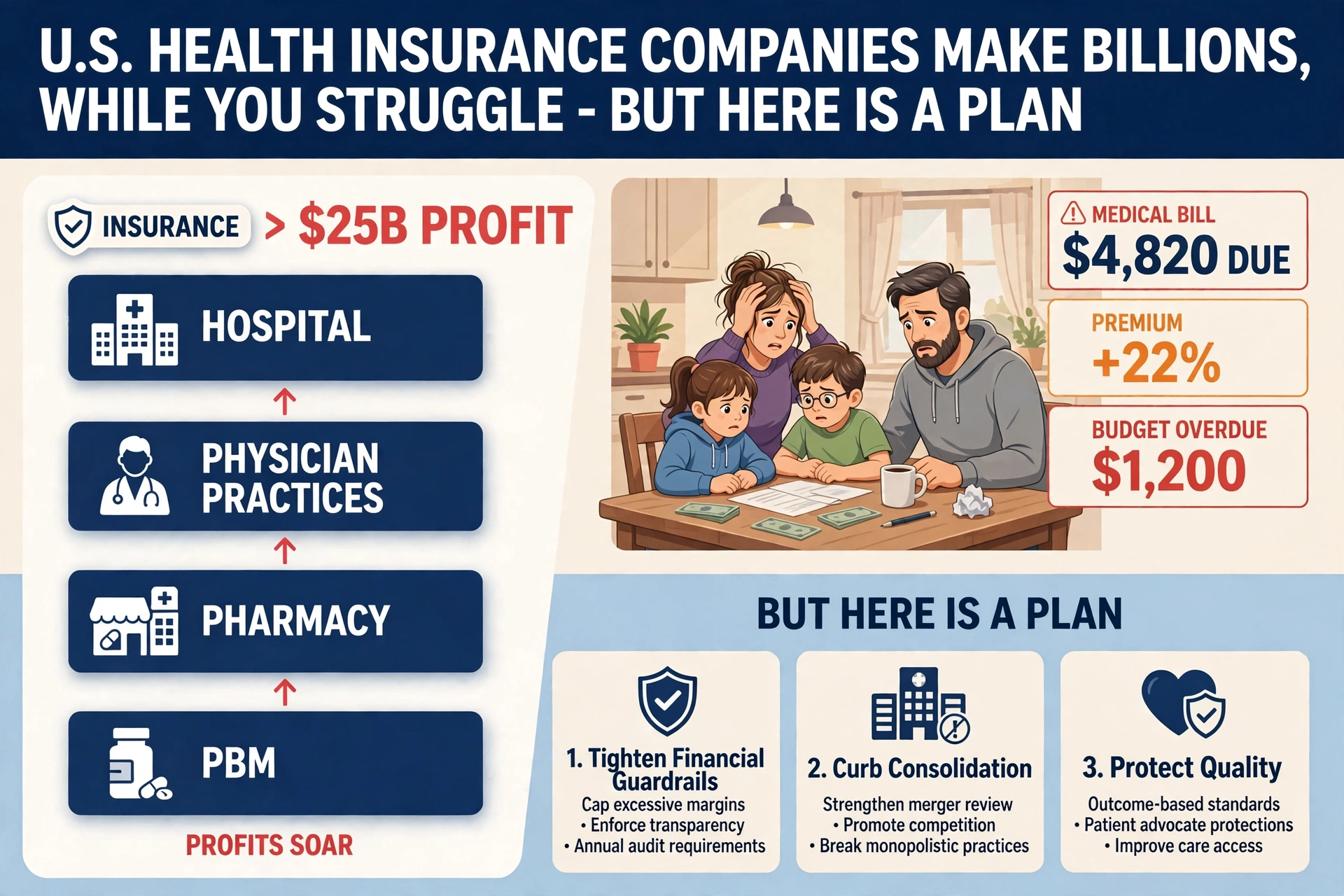
A Federal Plan to Rein In U.S. Health Insurer Profits
A summary of the policy brief, drawing on international models
The problem
Amid a U.S. health care affordability crisis, major for-profit insurers posted large 2025 net incomes: UnitedHealth Group $12.1 billion, Cigna $6 billion, Elevance Health $5.7 billion and Humana $1.2 billion driven by permissive regulation, weak price controls and heavy vertical integration, in which insurers own doctor practices and pharmacies. Rising costs force employers to raise employee premiums or slow wage growth, which strains household budgets.
Other high-income countries also use private and for-profit insurers, but their profits are limited:
-
Restricting Shareholder Payouts:In Switzerland: private insurers run compulsory basic care, but surpluses must stay in reserves rather than go to shareholders. CSS Group, which insures about 1.7 million people, kept a $137 million surplus in 2025.
-
Separating Essential and Supplemental Care: Australia, Singapore, and Germany guarantee universal or nonprofit statutory coverage guarantees essential services, and commercial insurers are largely limited to supplemental amenities or high-income niches.
What Counts as “Essential Services” (Public / Statutory Coverage)
-
-
-
Emergency & Inpatient Hospital Care: Ambulance services, emergency room visits, surgeries, and standard ward accommodations (typically shared rooms with 2 to 6 beds).
-
Primary & Specialist Consultations: Visits to general practitioners (GPs), pediatricians, and medically necessary specialists.
-
Diagnostic & Preventive Care: Lab tests, X-rays, MRIs, cancer screenings, and routine vaccinations.
-
Prescription Medications: Drugs listed on the country’s approved national formulary.
-
Maternity & Mental Health Care: Prenatal care, childbirth, and standard psychiatric or psychological treatments.
-
-
What Commercial Insurers Cover Instead – “Supplemental Amenities”
Because the government or nonprofit statutory funds already guarantee the medical treatment above, private commercial insurance in these countries focuses on how and where you receive that care:
-
-
-
Hospital Comfort: Upgrading from a shared public ward to a private or semi-private room.
-
Choice of Doctor: Guaranteed treatment by a senior consultant or chief physician rather than whichever doctor is on duty.
-
Speed & Convenience: Skipping public waiting lists for elective surgeries (like hip replacements or cataract surgery) by using private hospitals.
-
Allied Health & Extras: Routine adult dental care, vision (glasses/contacts), physiotherapy, chiropractic care, and alternative medicine.
-
-
(Note: In Germany, high-income earners above a certain salary threshold can opt out of the public statutory system entirely to buy comprehensive private insurance—which is what the text refers to as “high-income niche markets.”)
-
Regulating Benefits, Risk, and Prices: In the Netherlands, for-profit insurers offer basic coverage under strict rules. They must accept all applicants, offer standardized benefits, charge uniform community-rated premiums, take part in prospective risk equalization, and follow regulated or negotiated provider prices.
Why the U.S. is different
The United States combines permissive policies on every one of these dimensions. Even nonprofit Blue Cross Blue Shield plans have used regional dominance to limit competition, and investor-owned insurers profit directly from essential public and employer-sponsored coverage. Through vertical integration, conglomerates that own physician practices, pharmacies and pharmacy benefit managers (PBMs) can profit from both financing and delivering care.
U.S. guardrails are also fragmented. Benefit requirements vary widely, Medicare Advantage’s risk adjustment rewards aggressive diagnostic coding rather than prospective equalization, and commercial prices are left largely to market negotiation rather than standardized schedules like Germany’s.
States have tested pieces of the answer: Massachusetts with stricter medical loss ratios, Rhode Island with hospital price caps, and California and Oregon with consolidation oversight. But piecemeal state rules struggle against federal preemption and multi-state conglomerates, which is why there must be a unified federal approach.
Three federal reforms
1. Tighten financial guardrails
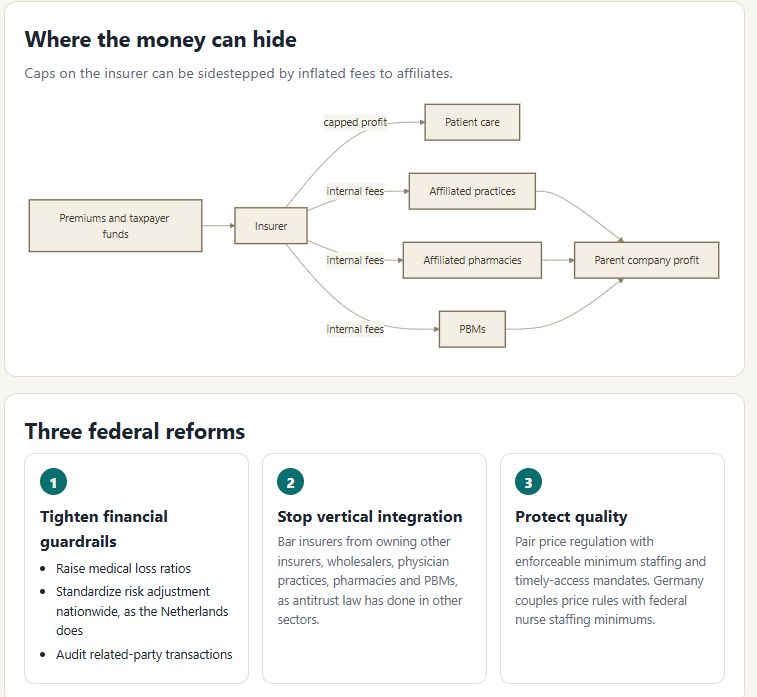
The problem. Many insurers are vertically integrated, so one parent owns the plan, the practices, the pharmacies and the PBMs. Even where rules cap an insurance subsidiary’s profit, companies can move money into unregulated affiliates through inflated internal fees.
The solution.
-
-
Raise medical loss ratios, so more of each premium dollar must go to patient care rather than overhead and profit.
-
Standardize risk adjustment, replacing Medicare Advantage’s diagnostic-coding incentives with prospective, nationwide risk pooling like the Netherlands uses.
-
Audit related-party transactions so insurers cannot disguise profit as payments to sister companies.
-
2. Stop Vertical Integration
The problem. Conglomerates control both the financing of care (collecting premiums) and its delivery (employing doctors and running facilities). That reduces competition, lets them dictate inflated prices and traps consumers inside one corporate ecosystem.
The solution. Stop health insurance companies from owning other insurance companies, drug or medical device wholesalers, physician practices, pharmacies, pharmacy benefit managers (PBMs), much as antitrust law has broken up monopolies in other sectors. Other high-income countries allow private insurance but rarely let one private entity dominate both the insurance pool and the clinical network to the degree seen in the U.S.
3. Protect quality
The problem. When price caps or revenue limits are imposed, as in Rhode Island, providers may respond by cutting nurse staffing, closing departments or restricting access to specialized care to protect margins.
The solution. Pair price regulation with enforceable minimum staffing and timely-access mandates. Germany couples strict pricing rules with federally mandated minimum nurse staffing for hospital departments.
Not socialized medicine
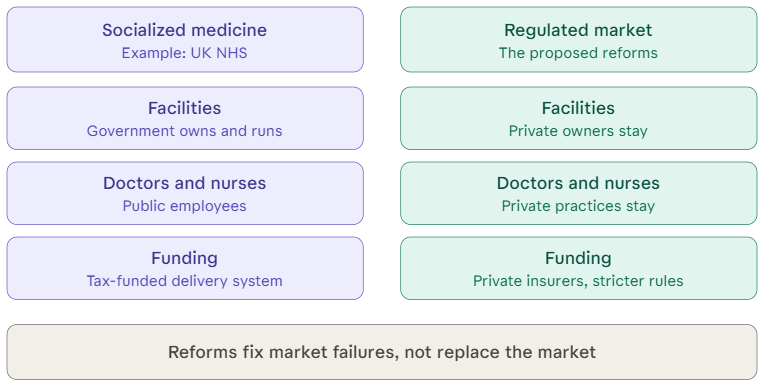
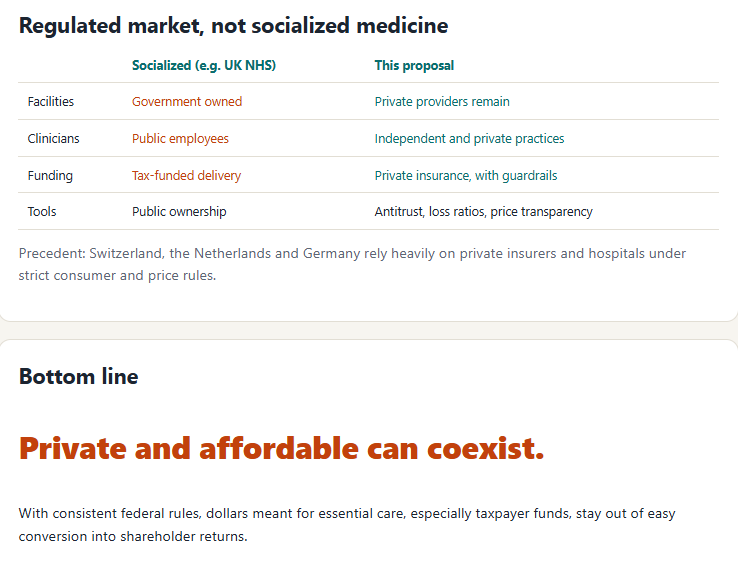
In socialized medicine, such as the UK’s National Health Service, the government owns and operates facilities, employs clinicians as public servants and tax-funds the whole delivery system. The proposed reforms do none of that. Private insurers, practices and providers remain. These reforms use traditional capitalist market rules to fix market failures:
-
Antitrust and corporate separation: like the Glass-Steagall approach to banking, to stop monopolies and vertical integration, forcing corporations to choose whether they want to be health insurers or healthcare providers, rather than owning the whole supply chain. This is meant to restore free-market competition among independent businesses.
-
Financial guardrails: Tightening rules on profit margins, medical loss ratios, or pricing transparency does not nationalize health care. It treats health insurance more like heavily regulated utilities or banking sectors, where companies can still earn profits but face boundaries on how they exploit captive consumers.
-
International precedent: Switzerland, the Netherlands and Germany rely heavily on private insurers and hospitals while enforcing strict consumer protections and price rules.
Bottom line
Private insurance can coexist with universal affordability, provided consistent rules keep dollars meant for essential care, especially taxpayer funds, from being easily converted into shareholder returns.
Op-ed: Private insurance needs public-interest rules
Health care should not force families to choose between paying the monthly premium and covering the rest of their household expenses. Yet rising costs are squeezing patients and employers alike. The question is not whether private insurance should exist. It is whether the rules governing it make care more affordable, transparent, and accountable.
The pasted text points to a structural concern: large companies can operate across multiple parts of the health-care system, from insurance and physician practices to pharmacies and pharmacy benefit managers. When those businesses share a parent company, money can move among affiliated entities in ways that are difficult for patients, employers, and regulators to evaluate. A rule that appears to limit profits in one part of the business may not tell the whole story if costs and payments shift elsewhere.
That is a reason for stronger oversight—not a reason to assume every integrated company is acting improperly. Regulators should have the information and authority to examine related-party payments, measure how much premium revenue ultimately supports care, and ensure that risk-adjustment systems pay plans fairly without rewarding inflated diagnoses. Clearer rules would help distinguish legitimate business costs from arrangements that undermine the purpose of consumer protections.
Competition matters, too. When one corporate group controls several links in the care chain, patients may have fewer meaningful choices and employers may find it harder to negotiate. Policymakers should assess whether particular mergers or ownership structures harm competition and access. Where evidence supports it, structural limits may be warranted. The goal should be to prevent market power from narrowing choices—not to break up companies simply because they are large.
Price regulation also needs a quality safeguard. If payment limits are imposed without attention to staffing, capacity, and timely access, providers may respond in ways that harm patients. Any effort to restrain costs should therefore come with measurable standards for safe staffing and access, plus monitoring that can identify service reductions before they become a crisis.
These policies do not require the government to own hospitals or employ clinicians. They are familiar tools of market oversight: disclosure, consumer protections, fair payment rules, competition policy, and quality standards. Private insurers and providers can continue to operate, but the public interest should set clear boundaries when essential care and public funds are involved.
The details matter, and the numerical and international comparisons in the pasted text should be independently checked before publication. But its central question is worth asking: are the rules ensuring that health-care dollars serve patients? A stronger, consistent framework could protect private coverage while insisting that affordability, access, and quality count alongside financial returns.
OP-ED – 750 words
You Pay More So Insurers Can Own Everything
Look at your kitchen table. Medical bill: $4,820 due. Premium notice: +22% renewal. Household budget: overdue $1,200.
Now look at Wall Street. UnitedHealth Group: $12.1 billion in net income last year. Cigna: $6 billion. Elevance: $5.7 billion. Humana: $1.2 billion. Together, over $25 billion in profit — from the same system that left your budget in the red.
Your employer feels it too. With healthcare costs soaring, every business in America faces the same ugly choice: pass the increase on to you in premiums, or quietly hold back your raise. Either way, you pay.
This isn’t because healthcare has to be this way. Every wealthy country struggles with health costs, but almost none lets insurers turn essential coverage into this kind of shareholder harvest.
In Switzerland, private insurers run compulsory basic care. CSS Group, one of the country’s leaders covering 1.7 million people, had a $137 million surplus in 2025. By law, that surplus stays in reserves to protect patients — it doesn’t go to shareholders.
In the Netherlands, for-profit insurers cover everyone, but under strict rules: they must take every applicant, offer the same standardized benefits, charge the same community price, share risk prospectively so no plan profits from cherry-picking healthy people, and accept negotiated provider prices.
In Germany, Australia, and Singapore, the government guarantees universal or nonprofit coverage for essential care. Commercial insurers fight for supplemental perks, not for your appendectomy.
America chose permissiveness on every front.
We let investor-owned companies profit directly from essential public and employer coverage. We let even nonprofit Blues plans use regional dominance to choke competition. We let benefit requirements vary by state, we let Medicare Advantage reward plans for making patients look sicker on paper to get bigger federal checks, and we let commercial prices be whatever a consolidated system can negotiate.
Most importantly, we let one company own the whole supply chain.
Today’s health giant doesn’t just collect your premium. It owns the hospital, employs your doctor, owns the pharmacy down the street, owns the pharmacy benefit manager that decides what your drug costs, and often owns the wholesaler that ships the drug. In our graphic, it looks like this:
INSURANCE > $25B PROFIT
↑ HOSPITAL
↑ PHYSICIAN PRACTICES
↑ PHARMACY
↑ PBM
When we cap how much the insurance arm can keep, it simply charges itself more for the other arms. An inflated fee to its own PBM or physician group moves the profit off the insurance books, out of regulatory reach, and into an affiliate. You still paid it. It just doesn’t count as “insurance profit” anymore.
This is not a free market. This is a closed loop.
States have tried. Massachusetts tightened medical loss ratios. Rhode Island capped hospital prices. California and Oregon built merger oversight boards. They are serious reforms, but a state insurance commissioner cannot regulate a $400 billion national conglomerate that can shift revenue across state lines with an internal invoice.
We need a federal market fix — not socialized medicine.
Socialized medicine is the British NHS: government owns the hospitals, government employs the doctors, taxes pay the bill. That’s not what we are talking about.
What works in Switzerland, the Netherlands, and Germany is a regulated market economy — private insurers, private doctors, private hospitals, competing hard, but inside consistent rules that prevent captive consumers from being exploited.
Three rules would change everything:
First, follow the money. Tighten medical loss ratios so more premium dollars actually pay for care. Standardize risk adjustment nationally, using prospective equalization like the Dutch do, not retrospective coding games. And scrutinize related-party transactions — if an insurer pays its sister PBM 300% more than the market rate, regulators should see it and disallow it.
Second, curb consolidation. Pass structural separation. The proposed Break Up Big Medicine Act is simple: you can be a health insurer, or you can own doctor practices, pharmacies, PBMs, and drug wholesalers — but you cannot be both. We did this with banks under Glass-Steagall and with telecoms under antitrust law. We forced companies to choose their business to restore competition. Healthcare deserves the same.
Third, protect quality. Price caps alone backfire if hospitals respond by cutting nurses. Rhode Island learned this. So pair every price rule with enforceable staffing and access mandates — like Germany’s federally mandated minimum nurse levels for hospital departments. If we limit revenue, we must require that savings come from efficiency and lower profits, not from unsafe staffing.
Critics will call this government takeover. It isn’t. It treats health insurance like what it is: a heavily regulated utility and financial service. We still have private banks, but we cap their risk. We still have private power companies, but we regulate their rates. We can still have private health insurers — and they can still earn a healthy return — but not by owning every step of care and converting taxpayer-funded premiums into shareholder returns.
The $25 billion question is whose side our rules are on. Right now, the rules let four layers of vertical integration funnel money upward to one profit line. A regulated market would flip that arrow — pushing accountability, competition, and care quality back down to your kitchen table.
That’s the plan.
While Australia, Singapore, and Germany all guarantee universal access to essential healthcare, they rely on very different funding engines: general taxation in Australia, mandatory personal savings + risk-pooled insurance in Singapore, and wage-linked statutory funds in Germany.
Australia: Tax-Financed & Publicly Administered
Australia funds its public Medicare system primarily out of general government tax revenue, supplemented by an income-based Medicare levy.
-
Taxes: Most taxpayers pay a 2% Medicare levy on taxable income (with exemptions or reductions for low-income earners). Higher earners without private hospital insurance face an extra Medicare Levy Surcharge (ranging from 1% to 1.5% depending on income) to nudge them toward private cover. Rather than sitting in a ring-fenced trust fund, these revenues flow into consolidated federal and state budgets alongside general taxes to fund public hospitals, GP subsidies (Medicare Benefits Schedule), and subsidized medicines (Pharmaceutical Benefits Scheme).
-
Mandatory Savings: None for healthcare.
-
Statutory Funds: No separate payroll-funded sickness funds; financing is government-budgeted and publicly administered.
Singapore: Mandatory Savings + Risk-Pooled Insurance
Singapore takes a shared-responsibility approach built around individual medical savings accounts layered with universal catastrophic insurance and heavy government subsidies.
-
Mandatory Savings: Workers and employers contribute a portion of monthly wages into MediSave, a mandatory personal medical savings account managed under the Central Provident Fund (CPF). Funds earn interest, roll over across a lifetime, and can be passed on—giving individuals skin in the game for routine and inpatient costs while letting them pay insurance premiums directly from their account.
-
Risk-Pooled Insurance: MediShield Life provides universal, lifelong basic coverage against large hospital bills and costly outpatient treatments. Premiums are risk-pooled across citizens and permanent residents, typically paid from MediSave.
-
Taxes & Subsidies: General tax revenues backstop the system through means-tested premium subsidies, targeted senior support packages, and safety-net grants (such as MediFund) for residents who cannot afford remaining bills even after MediSave and insurance.
Germany: Wage-Linked Statutory Funds
Germany uses a classic social health insurance (GKV) model funded through mandatory payroll contributions split between employers and employees, pooled through statutory health funds (Krankenkassen).
-
Statutory Funds: Around 90% of residents are covered by nonprofit statutory funds (Krankenkassen). Contributions are calculated as a percentage of gross wages up to an annual income cap (Beitragsbemessungsgrenze, or BBG—€69,750/year or €5,812.50/month in 2026), above which wages are not subject to GKV contribution calculations.
-
How Contributions Work: The base general contribution rate is 14.6%, split 50/50 between employer and employee, plus a fund-specific supplementary contribution (Zusatzbeitrag, averaging around 2.9% in recent years) also shared evenly between employer and employee. Funds are equalized centrally so insurers with older or sicker members are not penalized.
-
Taxes: General tax revenue plays a secondary role—primarily covering specific non-contributory costs (such as certain family/child benefits or federal grants) rather than serving as the main operating budget for essential care. (High earners above the compulsory insurance threshold can opt out into private health insurance).
Side-by-Side Comparison
| Feature | Australia | Singapore | Germany |
| Primary Funding | General taxes + 2% Medicare levy | MediSave (mandatory savings) + MediShield Life + subsidies | Statutory payroll contributions (shared employer/employee) |
| Mandatory Medical Savings? | No | Yes (MediSave) | No |
| Income Cap on Base Contribution? | No (levy applies on taxable income above thresholds) | CPF contribution ceilings apply to wages | Yes (BBG cap: €69,750/yr in 2026) |
| Role of Private Insurance | Supplemental hospital/extras; incentivized via surcharge for high earners | Integrated Shield Plans for higher wards/private care | Supplemental perks, or full opt-out for eligible high earners |
While all three systems protect residents from ruinous medical bills, they handle out-of-pocket costs and co-payments in starkly different ways: Australia relies on price “gaps” above government fee schedules with annual safety-net thresholds, Singapore uses explicit deductibles and co-insurance designed to keep patients cost-conscious while drawing on MediSave and subsidies, and Germany charges fixed nominal co-payments capped as a small percentage of household income.
Australia: Schedule “Gaps” & Safety-Net Thresholds
Public hospital treatment in Australia is generally free for public patients, while out-of-hospital care (like GP visits, specialist consultations, and diagnostics) is reimbursed against the Medicare Benefits Schedule (MBS).
-
How Co-Payments / Gaps Work:Medicare typically pays 85% of the MBS schedule fee for out-of-hospital services (or 100% for standard GP visits). However, doctors can set their own fees. If a doctor charges more than the MBS rebate—and does not “bulk bill”—the patient pays the difference (“the gap”) out of pocket. Subsidized prescription drugs under the Pharmaceutical Benefits Scheme (PBS) also carry standard patient co-payments (with lower rates for concession cardholders).
-
Caps & Safety Nets:Rather than a hard dollar ceiling on total annual spending, Australia uses Medicare Safety Nets that increase rebates once out-of-pocket costs cross annual thresholds (for 2026, the Extended Medicare Safety Net threshold is $2,699.10 generally, or $861.20 for concession cardholders and eligible families). Above that threshold, out-of-hospital rebates can cover 80% of remaining out-of-pocket costs, subject to per-item benefit caps.
Singapore: Explicit Cost-Sharing + MediSave Cushion
Singapore intentionally builds co-payment into its design to prevent overconsumption, pairing it with MediSave (mandatory savings) and means-tested subsidies so patients rarely face unmanageable cash shocks.
-
How Co-Payments Work:Under MediShield Life (and private Integrated Shield Plans), patients generally face an annual deductible (a fixed amount paid before insurance kicks in each policy year) plus co-insurance (a percentage share of the claimable bill above the deductible). Under updated rules effective April 2026 for new private Integrated Shield Plan riders, minimum deductibles range from $1,500 to $3,500 depending on ward/coverage tier, with a minimum 5% co-payment requirement and a co-payment cap of at least $6,000 (excluding the minimum deductible).
-
How Patients Pay:Out-of-pocket shares are often softened by government subsidies in public wards, paid from MediSave balances (within prevailing withdrawal limits), or backstopped by safety-net funds like MediFund for those in financial need. Policy claim limits also apply (such as MediShield Life’s $200,000 annual claim limit).
Germany: Small Flat Co-Payments & Income-Based Caps
In Germany’s statutory health insurance (GKV), essential care is mostly covered upfront, with modest flat or percentage co-payments on specific items and a strict income-linked cap.
-
How Co-Payments Work:Insured adults pay fixed or capped charges on select services—for example, €10 per day for inpatient hospital stays (up to 28 days per year), 10% of prescription drug costs (minimum €5, maximum €10 per prescription), and 10% (plus a small base fee/cap) for certain therapies or medical aids.(Note: Under Germany’s 2026 GKV stability reform, prescription and daily hospital co-payments are scheduled to rise starting January 1, 2027—for instance, prescriptions to 10% with a €7.50–€15 range and hospital stays to €15/day).
-
Caps & Exemptions:Annual co-payments are capped at 2% of gross household income (after family/child allowances), or 1% for qualifying chronically ill patients. Once a household hits its limit in a calendar year, it can apply for an exemption or reimbursement of excess co-payments.
Key Differences at a Glance
Dimension |
Australia |
Singapore |
Germany |
Primary Cost-Sharing Mechanism |
Provider fee “gap” above MBS rebates + PBS drug co-pays |
Annual deductibles + co-insurance percentages on bills |
Modest fixed/percentage co-pays on drugs, hospital days, and aids |
Protective Ceiling |
Safety-net thresholds boost rebates; per-item caps still apply |
Co-payment caps on riders + MediSave & subsidies + annual claim limits |
Hard cap at 2% of adjusted gross household income (1% if chronically ill) |
Where Financial Friction Hits |
Uncapped specialist/GP fees above schedule rates |
Higher ward classes, private care, or non-formulary/high-cost treatments |
Accumulating smaller routine co-pays until reaching the annual income cap |
Private supplemental health insurance plays a distinct strategic role in each country—functioning as a tax-nudged hospital and extras layer in Australia, an upgrade on top of catastrophic public cover in Singapore, and a dual-track system (add-on Zusatzversicherung vs. full PKV opt-out) in Germany.
Australia: Tax-Nudged Hospital & “Extras” Cover
In Australia, private health insurance sits alongside Medicare as an optional layer rather than a replacement for essential care. It is split into Hospital cover (private inpatient care, doctor choice, and bypassing public elective waitlists) and Extras/General cover (dental, optical, physio, and allied health).
-
How It Interacts with Public Care: Even with private hospital cover, Australians still use Medicare for GP visits and out-of-hospital diagnostics, and can still choose to be treated as a public patient in a public hospital. In private hospitals, private insurance covers accommodation and prostheses/medical devices, while Medicare covers part of the doctor’s fee and private insurance covers the remainder (up to agreed medical schedules—meaning out-of-pocket “gaps” can still happen if a doctor charges above the insurer’s schedule).
-
Incentives & Penalties: The government uses strong financial levers to shape uptake:
-
Medicare Levy Surcharge (MLS): Higher earners without eligible hospital cover pay an extra tax surcharge (1% to 1.5%), which rises above the base singles threshold of $105,000 for the 2026–27 income year.
-
Lifetime Health Cover (LHC) Loading:Waiting past age 31 (specifically after 1 July following your 31st birthday) to buy hospital cover adds a 2% loading per year of delay (up to 70%), lasting for 10 continuous years.
-
Means-Tested Rebate: Lower- and middle-income policyholders receive a government rebate on premiums, which phases down or hits 0% at higher income tiers.
-
Singapore: Integrated Shield Plans on Top of MediShield Life
Singapore builds private health insurance directly on top of MediShield Life (the universal basic catastrophic insurance layer) via Integrated Shield Plans (IPs) offered by private insurers, often paired with optional IP riders.
-
How It Interacts with Public Care: Rather than buying a completely separate policy from scratch, an IP integrates with MediShield Life so the policyholder gets one combined insurance layer that extends coverage from basic public ward levels up to higher public wards (such as B1 or A class) or private hospitals.
-
Premiums, Underwriting & Cost Controls: Base IP premiums can generally be paid using MediSave (subject to withdrawal limits), whereas riders—which reduce out-of-pocket deductibles and co-insurance—typically require cash payment. Unlike community-rated basic cover, private insurers underwrite IPs/riders based on health/age when applying and enforce strict cost-sharing rules (such as minimum deductibles and co-payment caps) to keep medical inflation in check.
Germany: Add-On “Zusatzversicherung” vs. Full “PKV” Opt-Out
Germany has two parallel private insurance pathways alongside its statutory health insurance (GKV): supplementary policies (Zusatzversicherung) for GKV members, and full substitution (PKV) for eligible groups.
-
Supplementary Insurance (Zusatzversicherung): GKV members keep their statutory coverage and buy targeted add-ons for things GKV limits or excludes—such as dental prosthetics, glasses/contacts, alternative medicine, single/double hospital rooms, or senior physician (Chefarzt) treatment. Insurers underwrite based on health/age at sign-up and often apply waiting periods.
-
Full Private Substitution (PKV):Employees earning above the annual threshold (€77,400 gross/year in 2026), along with self-employed workers and civil servants (Beamte), can opt out of GKV entirely into comprehensive private insurance (PKV). PKV sets premiums based on age at entry, health status, and chosen benefit level (not income), builds age-related reserves, and does not automatically cover non-working spouses/children for free the way GKV family insurance does—making switching back into GKV later difficult.
Comparison at a Glance
Feature |
Australia |
Singapore |
Germany |
Core Role |
Private hospital choice/waitlist relief + dental/optical extras |
Upgrades basic MediShield Life to higher wards or private hospitals |
Add-on perks for GKV members or full opt-out (PKV) for eligible groups |
Who Buys / Qualifies |
Open to anyone; heavily nudged via tax & age rules |
Open to residents/citizens (with health underwriting on private upgrades) |
Add-ons open to GKV members; PKV open to high earners (>€77,400 in 2026), self-employed & civil servants |
Key Policy Mechanism |
Community-rated cover + MLS tax surcharge & LHC age loading |
Integrated Shield Plans (IPs) + riders with deductibles & co-pay caps |
Risk-rated PKV premiums (age/health) + modular Zusatzversicherung |